REVIEW · ISTANBUL
Istanbul Old City: Basilica Cistern – Blue Mosque – Grand Bazaar
Book on Viator →Operated by Local Tour Guide Istanbul · Bookable on Viator
Three icons, one compact Istanbul walk.
This tour ties together Basilica Cistern and the Blue Mosque with a tight Old City route that makes your first hours in Sultanahmet feel organized, not chaotic. I like that you get a professional English-speaking guide and a small group that can flex to what you care about. I also like the practical bonus of pairing big-ticket landmarks with quick, scenic breaks so you’re not sprinting from one photo stop to the next.
One possible drawback: the Basilica Cistern ticket may cost extra if you don’t choose the all-inclusive option, and the shopping stops in/around the Grand Bazaar area won’t be everyone’s favorite style.
In This Review
- Key points before you go
- Basilica Cistern first: Justinian’s underground world (and why timing matters)
- Blue Mosque etiquette: modest dress, working mosque rules, and what to notice
- Hippodrome fragments and Sultanahmet Square views: quick hits, easy photos
- Church of Divine Wisdom: the Justinian-era anchor near Hagia Sophia
- Grand Bazaar sprint with Turkish delights and a carpet workshop
- Price and value: what you’re really paying for
- Small-group pacing in Sultanahmet: comfortable walking, flexible moments
- How to get more out of the tour: ask early, choose your vibe
- Who should book this Istanbul Old City highlights tour?
- Should you book it?
- FAQ
- How long is the Istanbul Old City tour?
- What group size should I expect?
- Is Basilica Cistern admission included in the price?
- What sites are included besides the Basilica Cistern and Blue Mosque?
- What should I wear for the Blue Mosque?
- Is the Grand Bazaar open every day?
Key points before you go
- Skip-the-queue help for Basilica Cistern can save real time in a line-heavy stop.
- Max 8 travelers means you get a more human pace through crowded Sultanahmet streets.
- Blue Mosque visit is free entry, but dress modestly or you’ll feel it fast.
- Grand Bazaar timing depends on the day; on Sunday it may be swapped.
- You also get Hippodrome + Sultanahmet Square viewpoints, not just indoor sites.
- Carpet workshop + Turkish delights add a local touch, with some shopping pressure possible.
Basilica Cistern first: Justinian’s underground world (and why timing matters)

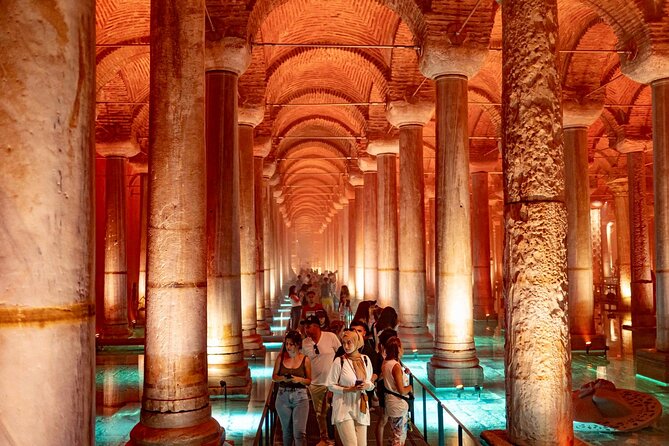
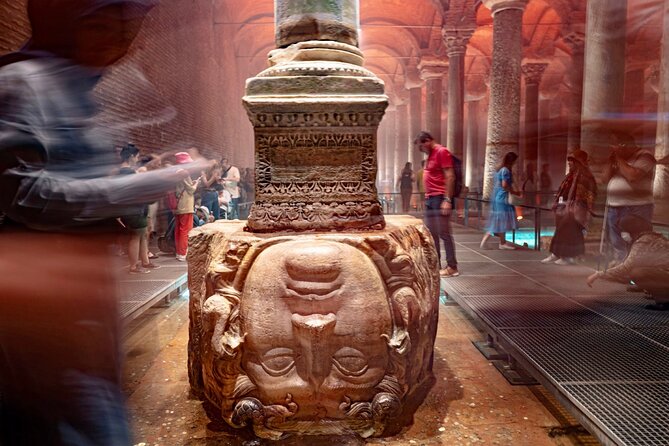
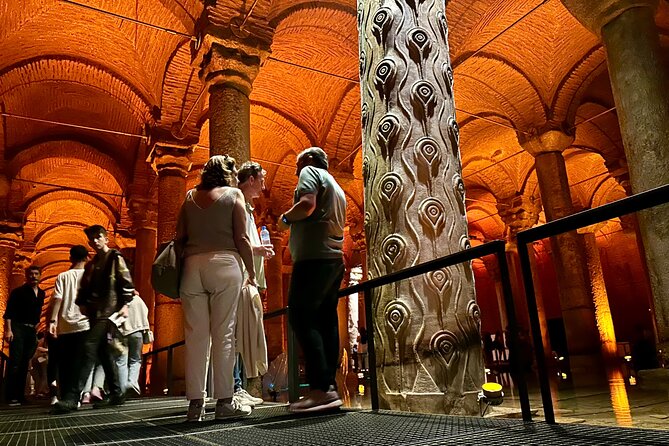
If you only do one “wow” stop underground in Istanbul, make it the Basilica Cistern. It’s the biggest of the Byzantine cisterns built under Emperor Justinian I (527–565), and it’s a huge space: 336 marble columns covering about 9,800 square meters. The scale hits you quickly. Then you start noticing the details.
This tour gives you about 30 minutes at the cistern, and that’s a good chunk for absorbing the room, spotting famous carvings, and not feeling like you’re only there to snap one picture. In particular, the Medusa-head carvings are often the moment people remember later. I like that with a guide, you know what you’re looking at instead of wandering around guessing.
The other big practical win is line management. If you’re not on an all-inclusive option, you still pay the cistern admission, and the setup is designed so you can avoid the ticket queue once you’ve handled your entry fee with your guide. That matters because the cistern can get slow when everyone’s funneling into the same narrow entry flow.
Rainy day tip: one review called it out as a great rainy-day plan. The cistern is underground, so it’s a lot more comfortable than an all-outdoor sightseeing day.
You can also read our reviews of more tours and experiences in Istanbul.

Blue Mosque etiquette: modest dress, working mosque rules, and what to notice
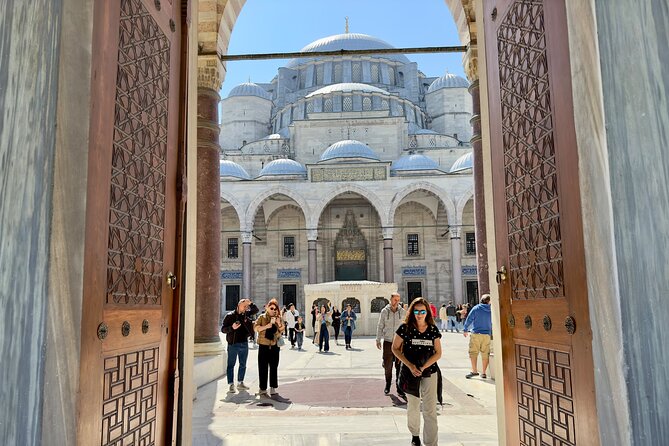
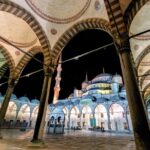
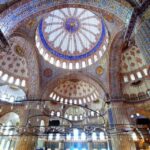
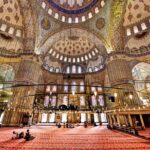
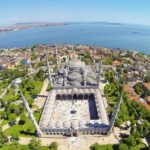
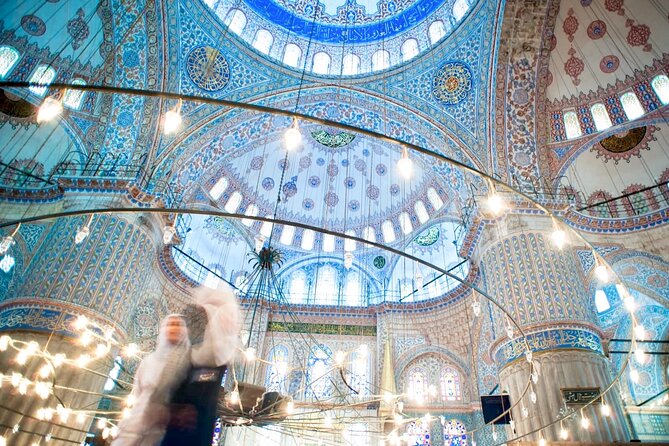
The Blue Mosque (Sultan Ahmed Mosque) sits right next to Hagia Sophia and is still a functioning mosque today. It was constructed between 1609 and 1616 under Sultan Ahmed I, and inside it’s famous for hand-painted blue tiles that cover the interior walls.
This stop is timed for about 30 minutes, and entry is free. That combination is a big reason this tour works as a highlights route: you get a high-impact site without eating your budget on ticketing for the mosque itself.
Here’s what you need to plan for before you walk in:
- Shorts for men or women should be below the knee
- Women need to cover their heads and also cover exposed shoulders with a scarf or shawl
- Skirts should be below the knee
Also note the simple reality of a mosque visit: it’s not a museum vibe. You should expect a more respectful, quieter experience than you’d get in a purely ticketed attraction.
What I think is worth your attention here: the mosque’s classic Ottoman design elements. The building has five main domes, six minarets, and eight secondary domes. A guide helps you connect those shapes to what you’re seeing, so the architecture doesn’t feel like random decoration.
Hippodrome fragments and Sultanahmet Square views: quick hits, easy photos
After the big indoor moments, the tour moves into the open-air heart of Sultanahmet. The Hippodrome of Constantinople used to be the city’s circus and social center, and today it’s basically a square with a few surviving fragments. Even without the full structure, it’s still a good history reset: this is where public life and spectacle happened.
You get about 20 minutes here, and the monuments are the draw. The tour highlights the 3,500-year-old Egyptian Obelisk and the Serpentine Column, which gives you something specific to look for rather than wandering a wide space.
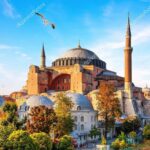
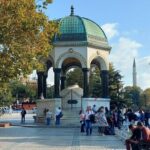
Then you’ll have a short break at Sultanahmet Square (about 10 minutes). This is the kind of stop I love on a short itinerary because it gives you room to breathe and reframe your photos. It’s a great spot to catch views toward Hagia Sophia and the Blue Mosque without forcing it into every single minute.
If you care about photos, this is your moment to slow down. The best shots often come when you’re not holding your camera at chest level while walking.
Church of Divine Wisdom: the Justinian-era anchor near Hagia Sophia
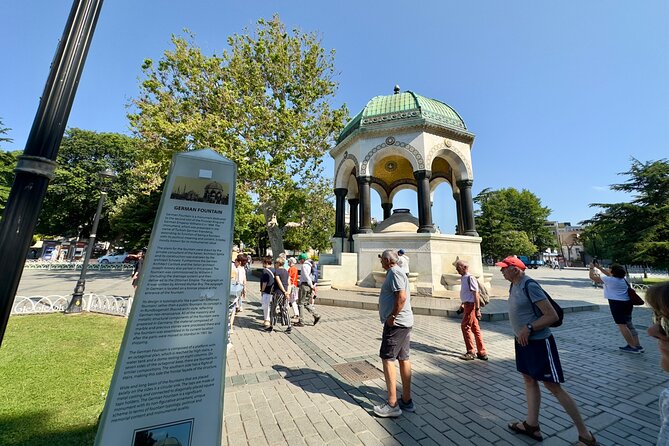
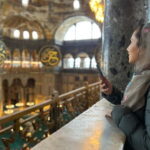
One stop that many highlights itineraries skip, but this one doesn’t, is the Church of Divine Wisdom (built in 532 AD). The tour frames it as a splendid monument that’s about 1,500 years old and notes it was built by Emperor Justinian in 532 AD.
Why it matters for you: when you’re standing in Sultanahmet, it’s easy to think in one storyline—Ottoman, then maybe Byzantine. This stop helps you connect the dots back to Justinian, the same emperor tied to the cistern. That link makes the area feel more like one layered location rather than a pile of separate landmarks.
It’s also the kind of site where a good guide makes it feel less like a name on a map. You’ll get context so it’s not just a quick “checkmark” between bigger attractions.
Grand Bazaar sprint with Turkish delights and a carpet workshop
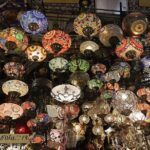
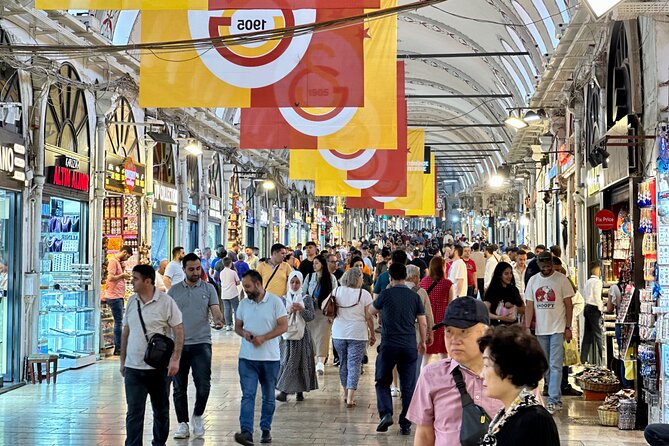
The Grand Bazaar is famous for a reason, but on a 3-hour highlights tour, the real question is pacing. You’re in and out in about 15 minutes, and admission is free. That’s enough time to get the vibe and maybe buy something small, but it’s not enough time to shop like you have a week.
What’s included here can add texture beyond the bazaar maze:
- Sampling Turkish delights
- Visiting a local carpet workshop
That workshop angle can be great if you want to understand what you’re seeing—how carpets are made and why prices vary. Still, it’s worth being honest with yourself: if you dislike shopping pressure, don’t wait until you feel it. Set the tone early with your guide and ask for a sightseeing-heavy approach.
There’s also a heads-up that matters a lot for planning: the Grand Bazaar is closed on Sunday. In cases where that happens, the tour may adjust the plan. One guide-specific story from a prior group mentioned swapping to the Egyptian Bazaar when the Grand Bazaar was closed, using tram to get there. That’s the kind of flexibility that makes a small group tour feel smarter than a fixed checklist.
If you go, treat this stop like a flavored sampler, not an all-day shopping expedition. Wander a few lanes, look closely at craftsmanship, and then decide if you want to go back on your own time later.

Price and value: what you’re really paying for
The tour price is $60.47 per person and it runs about 3 hours. On paper, that sounds like a lot of sights packed into a short window—and that’s exactly what you’re buying: structure plus a human guide in one of Istanbul’s busiest sightseeing zones.
Where the value shows up:
- Small group (max 8) keeps things from turning into a cattle-line experience
- A professional guide in English helps you understand what you’re seeing, not just where to stand
- The route groups top landmarks logically: cistern first, then Blue Mosque, then outdoor fragments and viewpoints, then the bazaar area
One crucial cost detail: Basilica Cistern admission may not be included unless you select the all-inclusive option. The provided information lists an extra fee of TRY 1,600 per person in one place, and 900 TL per person in another note. Either way, the point is the same: you should budget for the cistern ticket if you aren’t in the inclusive option.
In plain terms, the guide’s support around the cistern—especially avoiding the ticket queue—is often what turns this into a good deal. You’re paying for convenience and context, not just walking between sights.
Small-group pacing in Sultanahmet: comfortable walking, flexible moments
Sultanahmet is crowded. Even if you love crowds, you’ll still feel it. This tour helps because it’s a walking tour with a moderate amount of walking and a maximum of 8 travelers. That makes the difference between getting pushed and getting time to look around.
Another bonus: the tour is described as small-group and able to be customized to your interests. That flexibility shows up when you want to ask questions or slow down for photos. One highly praised guide, Huseyin Bagir, was noted for going above and beyond for a late lunch and adding extra local stops tied to what the group wanted—like a music instruments shop. You can’t count on every group getting extras, but you can absolutely expect the guide to handle questions with patience.
Practical note: a stroller can be challenging and isn’t recommended. If you’re traveling with a baby stroller, it’s smart to plan a different approach for this part of Istanbul.
How to get more out of the tour: ask early, choose your vibe
I’ve found the best tours feel like they’re built around how you travel, not how the itinerary wants you to travel. With this one, the easiest way to get that is simple: tell your guide what you care about at the start.
Here are the kinds of preferences that actually help:
- If you care most about architecture and history, ask for more time on the cistern details and Blue Mosque design elements.
- If you want photos, tell them early and ask where you can pause without feeling rushed—Sultanahmet Square is usually the moment for it.
- If you want minimal shopping, say it upfront. The carpet workshop and Turkish delights are part of the included experience, but you can still steer the rest.
One guide name that came up often in strong reviews is Tolga Kinas, praised for answering questions and matching the itinerary to different interests. Erol is another name that stood out for mixing fun with facts while also handling timing smoothly. If you land with a guide like that, you’ll likely feel like the tour has personality, not just facts.
Who should book this Istanbul Old City highlights tour?
This tour fits best if you want:
- A first-timer-friendly Istanbul Old City introduction
- Big landmarks in a short time window
- An English-speaking guide who helps you interpret what you’re seeing
- A group size that stays manageable (max 8)
It’s also a nice rainy-day option because at least one major highlight is mostly sheltered underground.
You might skip it (or choose a different format) if:
- You hate any shopping-adjacent stops
- You want a slow, long bazaar wander with time to buy
- You expect the tour to be fully wheelchair/stroller-friendly (stroller use is specifically discouraged)
Should you book it?
If your goal is to hit the highlights—Basilica Cistern + Blue Mosque + Sultanahmet viewpoints—in one organized, small-group outing, I think this is a strong choice. The price makes sense when you factor in the guide, the tight route, and the time saved around the cistern queue.
Just go in with two expectations set:
- The cistern ticket cost may be extra unless your option includes it.
- The Grand Bazaar stop is brief and includes a workshop/delight element, so it’s not a pure sightseeing sprint if shopping doesn’t interest you.
If you can handle that, you’ll leave with a clear understanding of why Sultanahmet feels like the core stage of Istanbul’s Byzantine and Ottoman eras.
FAQ
How long is the Istanbul Old City tour?
It runs for about 3 hours.
What group size should I expect?
The tour has a maximum of 8 travelers.
Is Basilica Cistern admission included in the price?
It depends on the option you choose. If you don’t select the all-inclusive option, Basilica Cistern entry is not included and you’ll pay an entrance fee in TRY to your guide.
What sites are included besides the Basilica Cistern and Blue Mosque?
You’ll also visit the Hippodrome, Sultanahmet Square, the Church of Divine Wisdom, and then the Grand Bazaar.
What should I wear for the Blue Mosque?
Modest clothing is required: shorts must be below the knee, women should cover their heads and also cover exposed shoulders with a scarf or shawl, and skirts should be below the knee.
Is the Grand Bazaar open every day?
No. The Grand Bazaar is closed on Sunday.