REVIEW · CAIRO
Cairo Private guided Tours visit old mosques & Islamic Cairo
Book on Viator →Operated by EMO TOURS EGYPT · Bookable on Viator
Cairo surprises you fast: it is not only pyramids, it is mosques with stories. This private 6-hour route lets you move through Islamic Cairo’s most famous worship spaces with a real guide, plus time at major landmarks like the Citadel. I especially like the tight, guided pacing across multiple sites, and the chance to connect the architecture to the way people actually pray.
One possible drawback to keep in mind: if your tour day has an access hiccup at the first stop or your day runs longer than expected with shop detours, you may feel like you lost time inside the mosques. Still, the overall experience tends to be guided, comfortable, and focused on what you came for.
In This Review
- Key points you’ll care about
- Why Islamic Cairo feels different with a private guide
- Price and value: what $45 gets you for 6 hours
- The practical day plan: pickup, timing, and how to be ready
- Stop 1: Al-Azhar Mosque and why it anchors the whole day
- Stop 2: Al Emam Al Hussein Mosque near Khan el-Khalili
- Stop 3: Sultan Hassan’s Mosque-Madrasa and its scale
- Stop 4: Cairo Citadel of Saladin—fortress to skyline
- Stop 5: Mosque of Amr ibn al-As in Old Cairo
- Stop 6: Muhammad Ali Mosque, also called the Alabaster Mosque
- Stop 7: Al-Rifai Mosque as a 19th-century partner to older monuments
- Lunch and local shopping: koshary and handicrafts along the way
- Friday prayer option: when timing changes the whole experience
- Who this tour suits best (and who should think twice)
- A balanced heads-up: where things can feel off
- Should you book this Islamic Cairo mosque tour?
- FAQ
- What is the duration of the tour?
- Where does pickup happen?
- What mosques and sites are included?
- Are entrance fees included?
- Is lunch included?
- Can I join Friday prayers?
- Is this a private tour?
- Does the tour include bottled water and an air-conditioned vehicle?
- Is free cancellation available?
Key points you’ll care about
- Hotel pickup and drop-off from Cairo or Giza keeps the day easy, not stressful
- Entry fees included means you spend more time looking, less time paying
- Al-Azhar Mosque is the anchor stop, with an option to join Friday prayers
- You’ll see major names in Islamic Cairo, from Amr ibn al-As to Muhammad Ali
- A local lunch stop for koshary is offered, but it is optional
- Your private group means you can ask questions and adjust your time
Why Islamic Cairo feels different with a private guide
If you’ve only seen Cairo through the postcard lens, Islamic Cairo can feel like the city’s other heartbeat. The streets around the mosques are full of everyday life, but the real value here is how quickly you start understanding what you’re looking at. A guide makes the details click: why a mosque was built where it was, what styles meant in their era, and how these places function today.
On a private tour, you also control the rhythm a bit. You’re not stuck waiting for a group that moves slower than you do, and you can ask for photos, context, or a few “what am I actually seeing?” answers before you move on. That matters because many of these buildings reward patience—especially Al-Azhar, Sultan Hassan, and the Citadel area.
Finally, if your schedule lines up with a Friday, the option to participate in prayer at Al-Azhar adds a deeper layer than sightseeing alone. Even if you only watch and learn, it changes the tone of the day.
You can also read our reviews of more tours and experiences in Cairo.

Price and value: what $45 gets you for 6 hours
At $45 per person, this tour isn’t about luxury. It’s about access and interpretation. The value comes from what’s included: a tour guide, hotel pickup and drop-off, an air-conditioned vehicle, bottled water, and entry fees.
That last part is big in Cairo. Entrance costs across multiple major sites add up fast, and collecting tickets while you’re squeezed between crowd timelines can feel like a chore. Here, you’re handed entry fees as part of the package, so your money goes directly into time at the sites.
What’s not included is the stuff you’d normally treat like extras: personal items, tipping, and lunch at the local restaurant (often koshary). The lunch stop is optional, which is helpful if you’d rather keep the schedule tight or prefer a different meal plan.
The practical day plan: pickup, timing, and how to be ready
This tour runs about 6 hours with pickup from your hotel in Cairo or Giza. The format is private, so it’s just your group in the vehicle. Expect multiple stops across Islamic Cairo, with a mix of longer and shorter visits—Al-Azhar gets the most time, while several other major sites are around 30 minutes.
Before you go, wear shoes you can walk in. The streets around Old Cairo and the mosque areas can involve uneven sidewalks and frequent “stop-and-look” moments. Also, plan your clothing with mosque visits in mind. Even when the tour is focused on sightseeing, these are active places of worship, so you’ll want clothing that helps you stay comfortable and respectful.
Stop 1: Al-Azhar Mosque and why it anchors the whole day
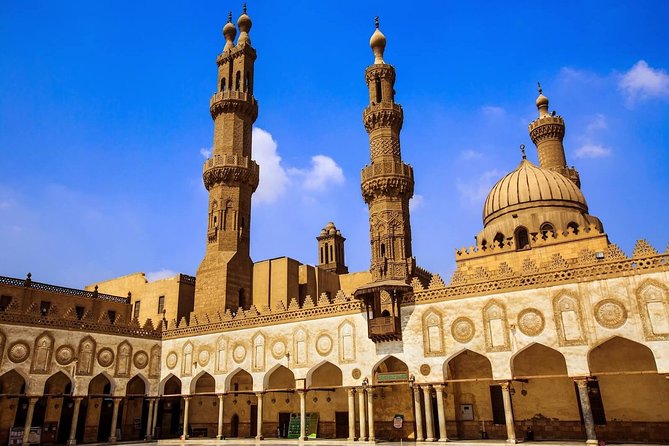
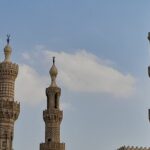
Al-Azhar Mosque is where the tour starts for a reason. Commissioned in 970 during the Fatimid era, it is known simply in Egypt as al-Azhar and is considered the first mosque established in Cairo. You’ll spend about 2 hours here, and the time matters because Al-Azhar is not a quick “see it and go” stop.
This is the kind of place where the guide’s context pays off. You’re looking at a site that people built into the core of Cairo’s religious and educational life. So you won’t just be seeing architecture—you’ll be learning why this mosque is treated as a landmark of Islamic scholarship and practice.
If your tour falls on a Friday, you may have the option to join prayers. That can be a memorable shift in how you experience the space. Instead of viewing it like a monument, you’re seeing it as something living and ongoing.
Stop 2: Al Emam Al Hussein Mosque near Khan el-Khalili
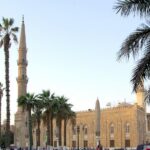
Next up is Al Emam Al Hussein Mosque, a mosque and mausoleum originally built in 1154 and later reconstructed in 1874. It sits near Khan El-Khalili in the Al-Hussain area, which helps explain why this stop often feels connected to the market energy around it.
You’ll have about 30 minutes here, so focus on what makes it significant: it is named after Prophet Muhammad’s grandson, Hussein ibn Ali. For many visitors, the place has weight because it is considered one of the holiest Islamic sites in Egypt. Some Shia Muslims believe Hussein’s head is buried on the grounds, within the mausoleum area.
From a visitor standpoint, this is also a great place to practice “looking slowly.” The guide can point out the parts of the complex that feel different from a typical mosque visit—because the mausoleum aspect changes the atmosphere.


Stop 3: Sultan Hassan’s Mosque-Madrasa and its scale
At the Mosque and Madrasa of Sultan Hassan, you’re in for a different kind of wow. Built between 1356 and 1363 during the Bahri Mamluk period, it was commissioned by Sultan an-Nasir Hasan. This is a massive mosque-madrasa, and it’s famous for architectural ambition and innovation.
Your time here is about 30 minutes, which is just enough if you keep your attention on the big picture. Think scale first: this is not an intimate corner stop. It’s a monument built for learning and worship, where architecture communicates power and purpose.
One practical tip: with such a landmark, photos can be tempting all the time. Try stepping back from your camera a few times. You’ll get more out of the visit if you occasionally look up and around, not just at one façade.
Stop 4: Cairo Citadel of Saladin—fortress to skyline
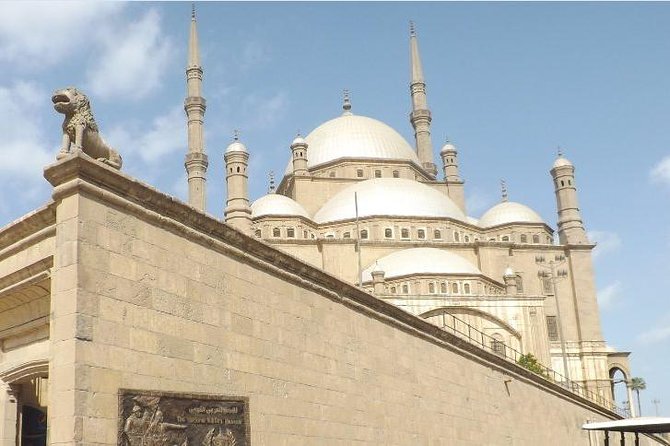
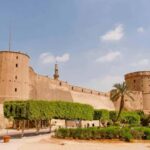
Then you move to Cairo Citadel, also called the Citadel of Saladin. Built as a medieval Islamic-era fortification by Salah ad-Din (Saladin) and later developed by Egyptian rulers, it served as the seat of government and the residence of rulers for nearly 700 years.
You’ll spend about 1 hour here, and the Citadel plays a useful role in the day. The mosques are spiritual and educational in tone, but the Citadel is where you understand political power and city planning. It sits on the Mokattam hills and overlooks Cairo, so even from a visitor’s perspective, it helps explain why this area became central.
The Citadel today is preserved and includes mosques and museums, so your guide can help you decide where to focus your time. If you like architecture and how a city grew, this stop adds structure to everything else you’ve seen.
Stop 5: Mosque of Amr ibn al-As in Old Cairo
The Mosque of Amr ibn al-As is another anchor, especially for people who want the earliest roots of Islamic Cairo. Originally built in 641–642 AD as the center of the newly founded capital, it’s often described as the first mosque in Egypt and all of Africa.
You’ll have about 30 minutes here. Even though the original structure is gone after extensive reconstruction over centuries, the mosque remains a prominent landmark you can still visit in what’s known as Old Cairo.
What’s helpful is that it’s an active mosque with congregants. When prayers are not taking place, it is open for visitors and tourists. That means you see the mosque as a working place, not only a historic building behind glass.
Look for the context your guide provides, like how the mosque’s location relates to the tent of the Muslim army commander Amr ibn al-As. Details like that are easy to miss when you’re sightseeing on your own, but they turn a quick visit into something memorable.
Stop 6: Muhammad Ali Mosque, also called the Alabaster Mosque
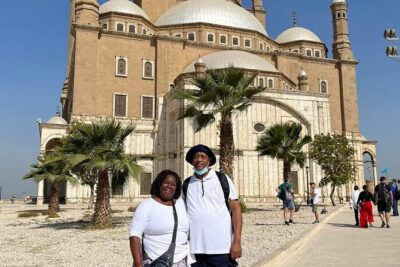
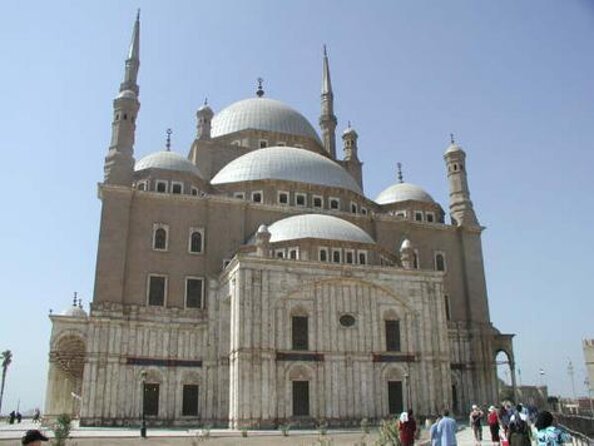
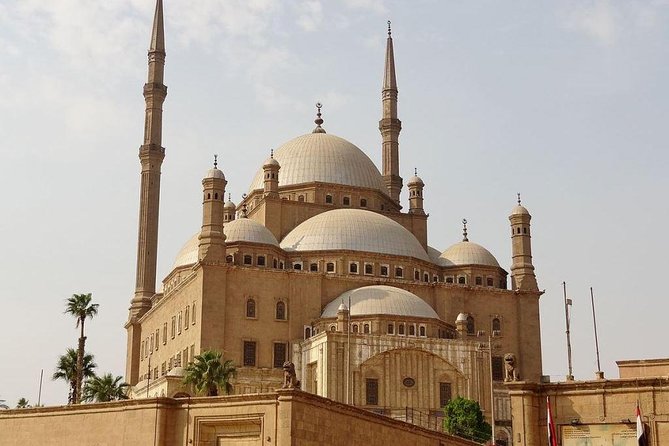
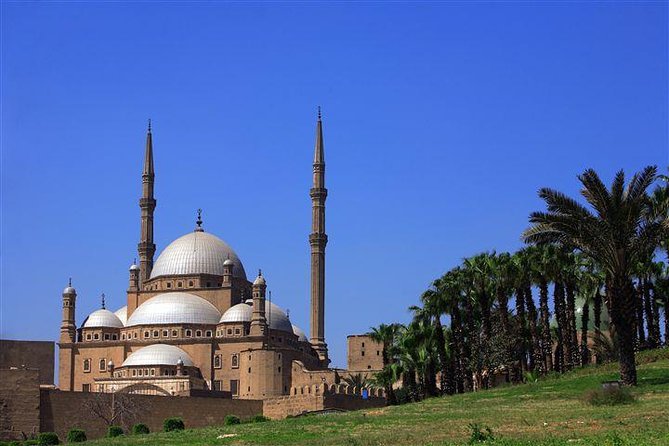
Next is the Mosque of Muhammad Ali, which many visitors recognize as the Alabaster Mosque because its outer walls are covered by alabaster stone. You’ll spend about 30 minutes here.
This stop is shorter, but it’s visually strong. The material choice is the clue: the outside treatment is meant to catch light and attention. Your guide can also help you link it back to the broader theme of today’s Cairo—how rulers and patrons shaped religious architecture across time, not just in one era.
If you’re a fan of photography, plan to spend a few minutes getting your angles right without rushing. With a short visit, the goal is to walk away with both a few great photos and a real sense of the building’s feel.
Stop 7: Al-Rifai Mosque as a 19th-century partner to older monuments
Finish with the Al-Rifa’i Mosque, located opposite the Mosque-Madrassa of Sultan Hassan. It’s designed as a complement to the older structure, tying the later period to the earlier grandeur across the street.
This is part of a bigger 19th-century pattern: Egyptian rulers aimed to associate themselves with the perceived glory of earlier Islamic history and also modernize the city. You’ll spend about 30 minutes here, and the best way to enjoy it is to keep bouncing between viewpoints—look at the mosque itself, then look back toward Sultan Hassan’s complex so the pairing makes sense.
Even if you don’t catch every architectural reference, you’ll feel the intention: the city isn’t only preserving old buildings, it is staging continuity.
Lunch and local shopping: koshary and handicrafts along the way
This tour includes a lunch stop option for classic Egyptian food like koshary. In practice, think of lunch as a reset. You’ve been inside and outside of large religious spaces and a major fortress site; food time helps you keep your energy up for the remaining stops.
You might also get a peek at traditional stalls for handicrafts and local shops. The areas around the major sites, especially near Khan El-Khalili, tend to offer that “Cairo beyond the monuments” feeling—where souvenirs are there, but so are everyday goods and textures.
One caution: some days can include more shop time than you want. If shopping is not your priority, tell your guide early that you want the schedule to stay sight-focused. You’ll usually get a better balance when you set that expectation up front.
Friday prayer option: when timing changes the whole experience
If you book for a Friday, Al-Azhar is the key moment. The tour notes the option to join prayers, and that’s a big deal for how you interpret the day.
From a practical angle, prayer time affects how long you can move around certain areas and how you should act. It’s not the moment to rush photos. Instead, treat it like a cultural moment where you learn by observing.
If you’re traveling at a slower pace emotionally, this can be one of those days where you walk out with a stronger sense of what these spaces mean.
Who this tour suits best (and who should think twice)
This is a great match if you:
- Want Islamic Cairo to feel guided, not random
- Prefer architecture and religious context over only broad photo stops
- Like the idea of seeing early and major mosques in one day, with entry fees included
- Might be traveling on a Friday and want the option of prayer
It might be less ideal if you:
- Hate shopping stops and want purely “inside the building” time
- Need a fixed schedule down to the minute and get stressed by changing site access
A balanced heads-up: where things can feel off
Two issues can show up on some days. First, the opening mosque can sometimes be unavailable for viewing, which can shrink the time you expected at the start. Second, a portion of time can be spent on shop stops—sometimes in places connected to tour partners.
Here’s how you protect yourself: when you meet your guide, ask them to confirm the flow for the day in plain terms. You want to know when you’ll have your longest mosque time and whether you’ll be stopping for shopping. If you don’t want shop time, say so early and politely.
With that simple approach, the tour’s strengths—comfortable transport, focused guidance, and real access—usually take over.
Should you book this Islamic Cairo mosque tour?
I think this is worth booking if you want a focused day across Cairo’s main Islamic landmarks, and you care about understanding what you’re seeing. The $45 price becomes much easier to justify because entry fees, guide, and pickup/drop-off are included, so your budget goes toward the experience rather than add-ons.
Book it if you’ll enjoy learning as you go, and especially if you might be there on a Friday and want the prayer option at Al-Azhar. Skip it (or at least prepare yourself) if you’re very anti-shopping and need the day to be strictly about interiors with no detours.
FAQ
What is the duration of the tour?
It runs for about 6 hours.
Where does pickup happen?
You can be picked up from your hotel in Cairo or Giza.
What mosques and sites are included?
The tour includes stops at Al-Azhar Mosque, Al Emam Al Hussein Mosque, Mosque and Madrasa of Sultan Hassan, Cairo Citadel, Mosque of Amr ibn al-As, Mosque of Muhammad Ali, and Al-Rifa’i Mosque.
Are entrance fees included?
Yes. Entry fees are included.
Is lunch included?
Lunch is optional. The tour mentions lunch at a local restaurant like koshary, but it is not required.
Can I join Friday prayers?
On Friday tours, you have the option to join prayers at Al-Azhar.
Is this a private tour?
Yes. It’s private, so only your group participates.
Does the tour include bottled water and an air-conditioned vehicle?
Yes. Bottled water and an air-conditioned vehicle are included.
Is free cancellation available?
Yes. You can cancel up to 24 hours in advance for a full refund.